
The Vuma Conservation Fund is a four-year, $65 million* pooled funding mechanism created with and for leading African community conservation organizations. It provides multi-year, unrestricted, core support so that grantees can grow their organizations, strengthen their strategies, and deliver greater impact for people, climate, biodiversity, and land and resource rights. The fund reflects the mandate provided by these conservation groups who have actively shaped its purpose, design, and principles through a participatory co-design process. Vuma seeks to increase the scale and quality of resources reaching Africa’s most outstanding community-led conservation organizations across the continent, paired with organizational development support that strengthens resilience and long-term effectiveness.
The fund is based on three financial components:
Grants to partners: $55 million over four years
This model assumes Vuma funds 25% of a partner grantee’s expenditure (with a maximum grant of $300,000 and minimum grant of $50,000) and considers the number of eligible grantees in Maliasili’s portfolio to grow from 66 to 90.
Organizational development: $7.5 million over four years
Maliasili’s primary service offering is organisational development (OD) to community-led conservation organisations. OD services are an additional offering of Maliasili’s pooled grantmaking and integral to the Fund because whole-organization investments are essential for long-term resilience and results. More specifically, OD as a key feature of the Vuma Fund:
Grantmaking and fund management: $2.5 million
In addition to OD support, Maliasili will provide grantmaking and fund management services. The Vuma Fund will be Maliasili’s third pooled funding initiative, building upon the Maliasili Landscapes Conservation Fund (2020-2022) and Maliasili Conservation Fund (2023-2026). Maliasili’s grantmaking and fund management services include:
The calculation for these services are based on the actual costs of Maliasili’s two previous funds and measures at just 4% of the total fund.
*The design of the Fund, including the funding formula and agreement with partners, is dependent on success in raising the full $65 million. Maliasili’s ability to implement the Fund as designed will be assessed at the end of 2026. Modification of the design, if necessary due to a fundraising shortfall, will be reviewed with the Partner Advisory Group.
Maliasili’s portfolio development and selection process is a key foundation for Vuma. Over time, Maliasili’s scoping, screening, and due diligence processes have become progressively more refined and detailed. Maliasili draws on the knowledge and networks of its team and a wide community of colleagues across Africa and beyond to understand which organizations are most strategic to support.
At a high level, Maliasili seeks to build a portfolio of the most important, high impact or high potential African civil society organizations working on community led conservation and natural resource governance. They look for organizations that work in critical ecosystems, often stewarded by marginalised communities, with strong leadership, a clear vision, and a commitment to strengthening their organizations to achieve greater impact. Maliasili always seeks organizations that put people at the center of their conservation model.
Identifying the right organizations to invest in is both critical and complex. Maliasili’s selection process is more than a checklist. It is about building relationships and understanding the true potential of an organization. On average, Maliasili holds around 12 in depth conversations with key stakeholders, including leadership, board members, funders, and technical experts. Maliasili explores their commitment to scaling impact, their approach to community leadership, and their ability to influence conservation practice and policy. They also look closely at organizational strengths and challenges, and at their willingness to invest in their own growth. Even for those Maliasili does not select, they aim to add value by offering reflections that can help them on their journey.
Malisili works with organizations of different sizes and stages. High impact in Maliasili’s context means that an organization has something important or distinctive in terms of its role or model. Malisili believes three elements are central to successful community led conservation and seeks partners that are doing important and effect work in one or more of these areas:
As of Maliasili’s new strategic plan (2026-2030), the organization will use country-level strategies to articulate the national-level outcomes in advancing community-led conservation that partners are working towards through their efforts. These strategies will also be important tools for guiding partner selections so that the constellation of partners across Maliasili’s portfolio in a particular country fully captures the diversity, potential, and situational landscape to drive the most change. Maliasili develops these strategies with partners based on their visions of change and their own organizational ambitions and goals, as well as the specific context and opportunities as those evolve in a country.
If an organization passes this initial screening, Maliasili may proceed to full due diligence. We then evaluate the organization through interviews with its team, board and other stakeholders, and a review of key documentation. Maliasili assesses:
Maliasili’s portfolio team shares its findings and recommendations with leadership and other teams before final decisions on new partners are made.
The most significant decision concerning access to resources is Maliasili’s partner selection process itself, since eligibility for the fund rests on the strength, readiness, and alignment established through this rigorous vetting and partnership model.
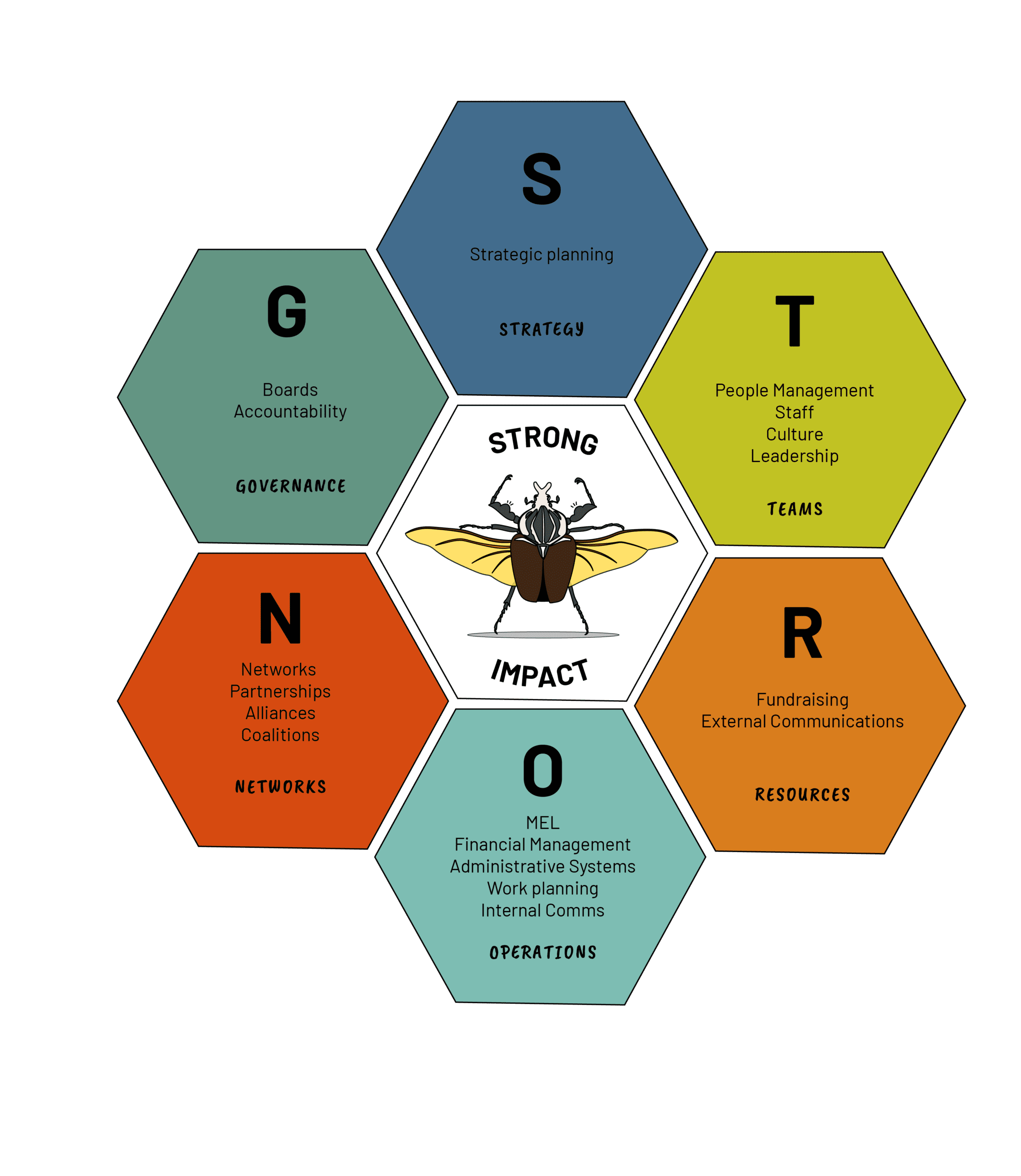
Once we launch a partnership, we expect at least four years of OD support for newly Active partners before they complete their full Organizational Development Plan (OSP) and become Advisory partners. Active partners receive hands-on OD support throughout the year. Together with their portfolio manager, they develop a OSP that identifies priorities across the STRONG framework (see figure below). OD support is then provided through tailored processes, coaching, facilitation, and strategic work that responds directly to the organization’s needs.
After approximately four years, partners transition to Advisory partner status, which entails lighter-touch, more ad hoc support. This allows them to draw on Maliasili’s support where it adds the most value, while continuing to lead their own organizational development with greater independence.
For Vuma, the most critical step in partner selection is this Maliasili portfolio process described above. All Vuma partners are drawn from Maliasili’s partner portfolio. However, being a Maliasili partner does not automatically mean immediate entry into Vuma.
In addition to the alignment and due diligence process to become a partner described above, there are some additional steps before a partner can qualify for Vuma funding as a grantee. An organization must also:
If Maliasili sees flags around any of these areas, it reserves the right to potentially pause or stop funding.
For a partner to receive its first grant from Maliasili, Maliasili first confirms their physical location and charitable use of grant funds to ensure the grantmaking complies with U.S. nonprofit tax law. Second, Maliasili explores with each partner their financial management practices, governance, and compliance with local regulations to find ways, if any, it can help them strengthen these internal processes ahead of new or renewed grants.
Many Vuma partners will have already gone through a strategic planning process with Maliasili and will have begun strengthening their systems for monitoring impact and managing finance. Where needed, Maliasili finance and OD teams work with partners to strengthen systems to match the scale and flexibility of Vuma funding.
Organizational development is at the heart of Maliasili’s work and is a core part of the Vuma model. Our approach is based on long-term partnership, grounded in trust, and focused on strengthening whole organizations so they can deliver the impact they seek in their landscapes and communities. We do not provide short-term consultancies for partner organizations. We work alongside them to strengthen the foundations that enable effective and lasting community-led conservation.
The STRONG framework guides how we support partners to grow. It reflects years of learning about what helps local organizations become more effective, more resilient, and better able to drive change.
Maliasili’s goal is to support organizations to get STRONG:
S: Strategy
A clear and compelling strategy helps an organization define its purpose, focus its work, and align its team. We support partners to sharpen or refresh their strategies so they can guide growth and decision-making.
T: Teams
People are central to organizational performance. We support partners to build capable, cohesive teams and leadership that can drive the organization’s mission forward.
R: Resources
Long-term and flexible resources are essential for mission-driven work. We help partners strengthen fundraising strategies, communications, and relationships so they can secure the resources they need and manage them well.
O: Operations
Strong systems and processes allow organizations to implement their work efficiently and responsibly. We help partners strengthen financial management, HR, planning, MEL, and other operational systems. Good operations underpin strong performance.
N: Networks
Organizations achieve more when they are connected. We help partners deepen relationships with peers, collaborators, and networks that strengthen their influence and collective impact.
G: Governance
Effective governance supports accountability, sustainability, and long-term resilience. We work with partners to strengthen boards or advisory bodies so they are well positioned to support the organization’s growth.
OD support is integral to Vuma because it:
OD support is therefore both a central value of the Fund and a practical mechanism that helps partners make the most of Vuma’s flexible, multi-year funding in terms of their long-term growth and organizational health.
The governance of the Vuma Conservation Fund reflects a shared commitment to strengthen community-led conservation through a model that is co-designed, equitable, and anchored in partner realities. The fund is guided by three groups with distinct but complementary responsibilities: Partners (grantees), Maliasili, and Funders. This structure combines partner leadership and insight, Maliasili’s administrative and fiduciary responsibilities, and funder participation in a way that protects the integrity of the fund while ensuring it remains grounded in its purpose and values.
Partners are at the heart of Vuma. They shaped the purpose and design of the fund and continue to guide its evolution. Their primary responsibility is to deliver impact in their landscapes and communities and to uphold the collective commitments that make the fund work. As it relates to Vuma, all partners are also grantees.
Key responsibilities of partners include:
Delivering impact
As Vuma grantees, partners are responsible for receiving, managing,sharing annual impact metrics, and utilizing their Vuma funding to advance their strategies, strengthen their organizations, and achieve the outcomes they have identified for their work.
Signing and Upholding the Vuma Partner Pact
By signing the Partner Pact, partners commit to shared principles, transparency within the group, responsible use of core funding, and constructive engagement with peers. The Pact provides a framework for expectations and norms as developed and maintained by the Partner Advisory Group.
Participating in peer learning and peer accountability
Through peer exchanges, cross-portfolio learning spaces, and the Advisory Group, partners support each other’s growth, help identify challenges early, and reinforce the collective strength of the fund.
Advising through the Partner Advisory Group
Partners influence how the fund evolves, how processes can be improved, and how the community of Vuma grantees upholds its shared commitments. The Advisory Group is a central space for partner voice and recommendations to Maliasili as the grantor.
Contributing to fund learning and improvement
Partners provide insights on what is working, where the model can be strengthened, and how Vuma can remain enabling and adaptive to changing contexts.
Maliasili serves as the grantor, fund administrator, and primary fundraising team for Vuma Fund. This role involves holding the legal, financial, and procedural responsibilities that enable the fund to operate effectively, fairly, and consistently. Maliasili acts as steward and facilitator, ensuring the fund reflects the mandate and values co-created with partners. Partners asked Maliasili to continue our role in grantmaking and fund administration to build on our established systems and functions and to avoid the need for them to develop and secure validation of a new entity and systems, which would require taking away capacity from their current operations.
Maliasili’s responsibilities include:
Grantmaking authority and compliance
Legal and regulatory requirements mean that final grant decisions must rest with the fund administrator. Maliasili must ensure that due diligence, documentation, reporting frameworks, and compliance systems are robust and consistently applied. Maliasili will draft, execute, and manage grant agreements with all partners receiving funds.
Financial stewardship and disbursement
Maliasili manages the financial flows, ensures responsible stewardship of donor funds, and maintains governance, compliance, and administrative systems that protect both the fund and its partners.
Fund administration and process management
This includes managing readiness assessments, the funding allocation formula (designed with partners), reporting systems, and OD resource allocation. Maliasili and funders will sign grant agreements.
Fundraising and donor stewardship
Maliasili leads fundraising efforts, supported by partners where appropriate. Maliasili ensures that fund disbursement aligns with donor restrictions and with the purpose and operating principles of the fund.
Safeguarding values and consistency
Maliasili protects the transparency, equity, and predictability of the fund. This includes ensuring that the 25% of partner expenditures formula, the $300,000 max/$50,000 min individual grant amounts, and the reporting and OD support model are applied equitably.
Funders play an important role in supporting Vuma’s long-term vision and contributing to a more equitable and effective philanthropic ecosystem. While funders do not have decision-making authority within the fund’s operations or grantmaking, they are important partners in learning, resourcing, and strengthening systems that support locally led conservation.
Funders’ responsibilities include:
Resource the fund
Funders are key to enabling the shift of resources to effective locally led conservation organizations demonstrating impact or early promise of impact and working on the frontlines. Funders and Maliasili will enter into grant agreements that outline the funder’s commitment of resources and other terms.
Participate in learning spaces
Vuma donors can support the fund’s work beyond simply giving and, in addition, benefit from being part of the Vuma community. Optional opportunities may include:
Champion Vuma and partner organizations
Funders can amplify the work and leadership of partners by sharing insights, building relationships, and encouraging better practice across the philanthropic field. It is important to emphasize that Vuma is ultimately part of a wider effort involving all parties - Maliasili, the African partner/grantees, and the funders - to shift African conservation and climate funding to provide more effective and sustained funding to African civil society organizations. Funding partners play a critical role in championing that cause, based on the impacts and outcomes that Vuma supports and its overall vision of change.
A core principle of Vuma is that funding intended to strengthen local organizations must be shaped and guided by those organizations. Growing from experience with previous funds such as the Maliasili Conservation Fund (2023-2026), Vuma partners have been active co-creators from the start. The design, structure, governance ethos, and funding model reflect the insights, priorities, and collective vision of more than 60 African conservation organizations.
To formalize and sustain this leadership, the creation of a Vuma Fund Advisory Group involving all partners was proposed. This group embodies the commitment to shared accountability, mutual support, and collective stewardship of the fund. It is a partner-led mechanism that ensures the fund remains relevant, principled, adaptive, and accountable to its collective mission.
The Vuma Fund Advisory Group exists to strengthen the partner community, uphold the principles of the fund, and help shape recommendations that ensure Vuma delivers on its promise of greater, faster, community-led impact. The group’s role includes:
Partners will author, refine, and approve the Vuma Pact. The Pact sets out shared principles, commitments, and expectations for how partners will use core funding, how they will support each other, and how they will uphold the reputation and effectiveness of the collective.
Because Vuma is designed around shared impact, the Pact reinforces that the success of one partner contributes to the strength of all partners, and that a failure to perform can affect the credibility of the entire group. This shared accountability is a cornerstone of Vuma’s design.
Vuma includes several layers of peer engagement across the portfolio. The Advisory Group provides a home for these conversations, helping to guide:
These exchanges help partners lift each other up, strengthen performance across the fund, and ensure the model is continuously improving.
The group helps open channels for deeper collaboration on land rights, wildlife management, community governance, restoration, policy engagement, and other shared priorities.It also helps partners coordinate around emerging opportunities or risks across landscapes.
Pooled funds can limit direct funder-partner engagement. The Advisory Group plays a role in shaping periodic touchpoints where funders can hear directly from partners, learn about progress, understand challenges, and strengthen trust and understanding.
Because Vuma is designed to shift funding practices, the group can help capture and communicate partner experiences, demonstrating how core, long-term funding drives strategic impact. This strengthens the wider movement for locally-led conservation and helps secure future funding for the sector.
There are two fundamental structures through which the Advisory Group will engage.
Vuma Fund Advisory Group: The Vuma Fund Advisory Group will include all CEOs or designated leaders of all grantee organizations participating in the fund. Maliasili team members who work on fund management will assist in organizing the meetings.
In the near-term, the meetings will be virtual, though the structure may evolve to include in-person convenings. Meetings may include:
To reduce power imbalances and create a space where partners can speak openly and lead the agenda, Maliasili will convene the group but will not fully facilitate discussions. External or self-guided facilitation will support autonomy and keep the focus on partner voice and leadership.
The Vuma steering committee: For more regular engagements between grantees and Maliasili, a small steering committee comprising approximately 8 select members of the Advisory Group will be maintained. This committee will have quarterly meetings with Maliasili fund managers and report back to the Advisory Group via email and online meetings where necessary.
Partners are selected through Maliasili’s due diligence and long-term relationships. Through Vuma, each partner grantee will receive a grant in the amount of 25% of Fiscal Year 2025 annual expenditures, with a maximum grant amount of $300,000/year and a minimum grant amount of $50,000. Funding is unrestricted, multi-year, and tied directly to each partner’s strategic plan. Oversight comes through Maliasili’s grant administration and reporting systems. Additional support is provided through strategically deployed OD expertise, strengthening leadership, governance, and resilience across the portfolio.
Each of these features is delineated in detail below.
Vuma is built on the idea that if every organization in the fund has gone through the same rigorous Maliasili partnership process, then everyone can trust that the others are legitimate, aligned, and serious about impact. Eligibility for Vuma therefore rests first on being a Maliasili partner.
Because Vuma is designed as a collective effort, partners are not only accountable to Maliasili. They are also accountable to each other. In addition to being Maliasili partners and being ready in strategic and organizational terms, Vuma partners sign onto and uphold the principles of the Vuma Partner Accountability Pact.
The Pact sets out shared expectations for how partners will use core funding, how they will share learning, and how they will uphold the integrity and reputation of the fund. Upholding the Pact is part of what keeps the circle of trust strong. If one partner consistently fails to meet agreed commitments, it affects the credibility of the whole group. The Pact together with the Vuma Fund Advisory Group, provides a framework to address such issues through support, peer feedback and, if necessary, recommendations on future participation.
The Working Group placed significant weight on ensuring that the Vuma model is equitable across organizations, transparent, simple to explain, and grounded in evidence of what works for organizational strengthening.
Over six years of pooled fund experience, including MLCF and MCF, Maliasili and partners learned that:
This evidence base was used in the Working Group’s decision-making.
During the co-design process, partners made three points clear:
25% of an organization’s annual expenditure in the year before the launch of Vuma was chosen as a benchmark because it is:
25% is therefore the sweet spot between ambition and prudence.
Partners did not want a model where Maliasili exercises discretion or judgment about how much each organization receives. Proportional funding, set at 25% with associated minimum ($50,000) and maximums ($300,000), ensures:
This would create inequity and limit the number of organizations that could join the fund as well as create further unpredictability around the total fundraising goal. Setting the cap at $300k achieves these aims. It ensures:
Principally, $65 million was derived from an analysis and projection around Maliasili’s portfolio’s growth of partners, partners’ expenditures, and the 25%/maximum/minimum grant amounts described above. In addition, Maliasili analysed current funding trends and patterns, and confirmed that this number, based on MCF commitments and momentum in the sector around locally-led conservation, is an ambitious but realistic fundraising goal.
To fundraise for Vuma, Maliasili draws upon the lessons from MCF and MLCF to inform its strategy. This includes doing a time-bound campaign (close funding commitments by Q3 or Q4 FY26), which creates clear parameters for the Fund’s goal, timeline, and clarity for both donors and partners.
Additionally, Maliasili was deeply honored to receive its second MacKenzie Scott grant in October 2025 in the amount of $15m and has chosen to invest $10m of this sum into Vuma. This choice is not only central to Maliasili’s mission and value of “walking the talk” but also signals buy-in, credibility, and momentum for funders and partners alike.
The last two elements critical to fundraising for Vuma are the role of existing collaborations and long-term partnerships with existing funders to draw in new donors as well as intentional collaboration with Maliasili partners (grantees) in engaging their networks to create enthusiasm and secure funding.
Partner participation in fundraising is an important part of building the Vuma Conservation Fund, but it is designed to be structured, voluntary, and aligned with partners’ priorities and capacity. Maliasili leads fundraising in its role as fund administrator. Partners contribute in specific, clearly defined ways that strengthen the collective case for Vuma without shifting the full fundraising responsibility onto local organizations. Partners may participate through the following channels:
From 2026 onwards, Maliasili will engage in, take advantage of and coordinate donor visits and learning journeys that showcase partner work and the impact of community-led conservation. These visits are intended to give funders direct exposure to local leadership, community-led conservation impact, community governance models, and conservation outcomes on the ground.
Partners may be invited to:
These engagements will be planned on a quarterly basis. Partners who are invited to participate will be informed well in advance. Participation is voluntary, but it is an important contribution to building understanding and confidence in the fund at the scale Vuma is seeking to achieve.
Partners may be asked to contribute to communications and impact materials that support the collective narrative of Vuma. This includes materials that demonstrate the value of unrestricted, long-term funding for community-led conservation.
Examples include:
These materials are used to reinforce the case for Vuma and similar funding models. Maliasili coordinates and supports this work, with sensitivity to partner capacity and context.
Partners often participate in regional and global events where they present their work. Vuma encourages partners, where appropriate, to help amplify the broader narrative around enabling funding models and locally led conservation.
This may include:
The emphasis is on building visibility for approaches that support local leadership and scale impact, rather than promoting the fund as a brand.
Guiding principles for partner participation
Partner participation in fundraising-related activities is guided by the following principles:
This approach ensures that funders can hear directly from local leaders and learn from their experience, while protecting partners from the risks and burdens often associated with process management.
Vuma runs through the end of 2030. The fund is designed both as an ambitious pooled mechanism and as a model that demonstrates what is possible when long-term, unrestricted funding is paired with organizational development support and partner leadership. The Fund’s goal is that partners will be more impactful, stronger and financially resilient by the end of this period, and that with or without continuation funding, they are set up for success.
By 2030, the aim is that:
Decisions about continuing, expanding, or replicating the fund beyond 2030 will be made together with partners, based on learning and the needs of the moment.
Do you have further questions? Please let us know or reach out direct to Resson Kantai Duff, Director of Portfolio Funding, at rkantaiduff@maliasili.org.